
My First Bosnian-Language Audiobook: A1 Bosnian Short Stories
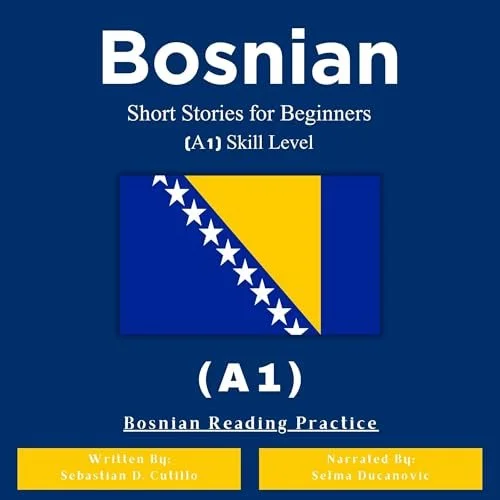
Earlier this year, I was honored to accept a project narrating a Bosnian language learning book that had passages in both Bosnian and English. This was my first of such kind of project, and the first time I would need to use my Bosnian in my professional career beyond a few simple words or phrases. I knew that this would be a new experience, but I didn’t realize how much internal angst would get brought up in regards to language and culture.
As a brief history, I was born in Germany where my parents were refugees during the Bosnian Genocide. We moved to Seattle when I was only two years old. Because my parents didn’t initially speak English, my first language and mother tongue will always be Bosnian. It was the language we spoke at home. However, much can be said for receiving an education in a different language because once I began school, my English quickly surpassed my Bosnian. We still had Bosnian cultural activities – like folklore and mejtef – where we would still speak Bosnian, but the lack of real-world experience certainly took a hit on our abilities.
I described this phenomenon to a colleague of mine this past summer. When you live in a country with a certain language, you go to the movies, to the post office, to the pharmacy, to the doctor, etc and over time your vocabulary knowledge naturally expands. However, when you only speak a language at home, your vocabulary gets stunted. I needed to go the post office this past summer, but embarrassingly I didn’t know the word for stamps or postcard. I also wanted to inquire about certain documents, but I didn’t know the words for certificate or identification. I speak Bosnian, fluently, but the fact that I don’t live there contributes to a knowledge gap that can be very mortifying when it comes out. I understand everything that everyone else is saying when they speak, because context clues are there, but when it’s my turn to start saying something, if we’re talking about a topic beyond my narrow vocabulary, it becomes difficult to express myself.
Because of all this, I was excited to start this project. Something new, right? New vocabulary (even if a little basic) and a brush up on my Bosnian reading skills is always a good thing.
Even though I did need to go to my parents for help on pronouncing certain words, I feel that I did a good job on the project. It was interesting going through it though, since the stories were clearly aimed for learners that come from English-speaking cultural contexts. That was something that I had to adjust to. Overall, though, I think they were good introductory short stories to the language.
Check out “Bosnian Short Stories for Beginners (A1) Skill Level” on Audible.
Also check out the next book “Bosnian Short Stories for Beginners (A2) Skill Level” on Audible.
xx,
Selma